Summary
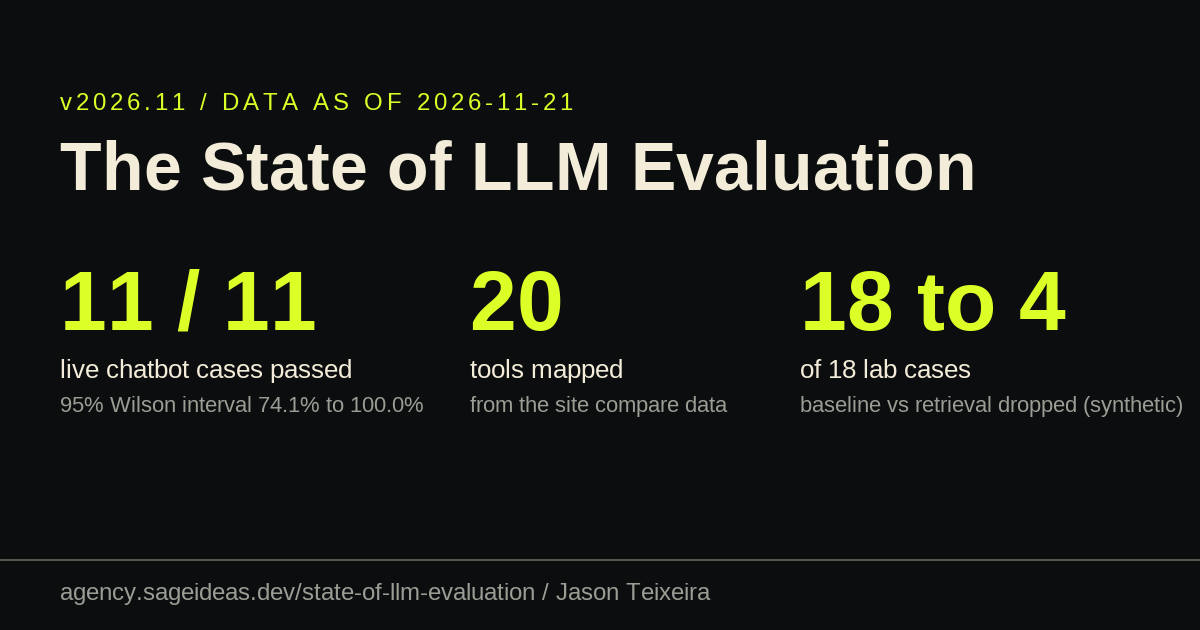
- 20tools in 3 categories (Eval frameworks, Eval platforms & observability, Guardrails & safety)
- 11 / 11live chatbot eval cases passed; the 95% interval is 74.1% to 100.0%
- 18 to 4of 18 lab cases when retrieval is dropped (synthetic, scripted)
The tool market sorts into four jobs rather than forty products . The measured part is small on purpose: a suite of 11 cases that all pass still allows a true pass rate as low as 74.1%. That is the honest size of the claim, and the reason the sizing table sits next to the results.
Methodology
- Source rule. A number appears only if it is read from a file in this repository or computed by this repository's own code. Each one has a hidden source marker in the page and a row in
docs/STATE-OF-EVAL-SOURCES.md. - Intervals. Every interval is a 95% Wilson score interval from the repo function
wilson()insrc/lab/eval-gate/model.js. - Tool table. Built only from this site's own compare pages, dated 2026-11-21. Descriptions and license wording are copied from those pages, not from vendors .
- Not included. No prices, rankings, star counts, benchmark scores or vendor claims. Published research and industry surveys are not included either, because no source for them is cited in this repo; they will be added only when a primary source has been read and linked.
Tool landscape
| Tool | Category | What it is, per our compare page | License, per our compare page | Compared on |
|---|---|---|---|---|
| Braintrust | Eval frameworks / Eval platforms & observability | General eval and logging platform | Commercial / hosted | confident ai vs braintrust langsmith vs braintrust braintrust vs langfuse |
| Confident AI | Eval frameworks | Hosted platform for DeepEval | Commercial / hosted | confident ai vs braintrust |
| DeepEval | Eval frameworks | A pytest-style eval library for Python | Open source | promptfoo vs deepeval ragas vs deepeval |
| Giskard | Eval frameworks | A Python library that auto-scans models for issues | Open source | giskard vs promptfoo |
| OpenAI Evals | Eval frameworks | An eval framework with a shared eval registry | Open source | openai evals vs promptfoo |
| Promptfoo | Eval frameworks | A config-driven eval runner + red-teaming tool | Open source | promptfoo vs deepeval promptfoo vs ragas openai evals vs promptfoo |
| RAGAS | Eval frameworks | A RAG-focused metric library for Python | Open source | promptfoo vs ragas ragas vs deepeval trulens vs ragas |
| TruLens | Eval frameworks | Tracing and feedback-function evals for LLM apps | Open source | trulens vs ragas |
| Arize Phoenix | Eval platforms & observability | Open-source LLM tracing and eval tool from Arize | Open source | arize phoenix vs langsmith |
| Galileo | Eval platforms & observability | LLM observability and eval platform | Commercial / hosted | patronus ai vs galileo |
| Humanloop | Eval platforms & observability | Prompt management, evals, and observability platform | Commercial / hosted | humanloop vs promptlayer |
| Langfuse | Eval platforms & observability | Open-source LLM observability and evals | Open source (open-core) | langsmith vs langfuse braintrust vs langfuse |
| LangSmith | Eval platforms & observability | Tracing, evals, and prompt tooling | Commercial, hosted (self-host available) | langsmith vs braintrust langsmith vs langfuse arize phoenix vs langsmith |
| Patronus AI | Eval platforms & observability | Eval and safety platform with its own judge models | Commercial / hosted | patronus ai vs galileo |
| PromptLayer | Eval platforms & observability | Prompt registry and request logging, plus evals | Commercial / hosted | humanloop vs promptlayer |
| W&B Weave | Eval platforms & observability | W&B's LLM tracing and eval SDK | Open-source SDK with a hosted backend | wandb weave vs braintrust |
| Guardrails AI | Guardrails & safety | Output validation and structure enforcement | Open source | guardrails ai vs nemo guardrails |
| Lakera Guard | Guardrails & safety | Hosted API for injection and safety detection | Commercial / hosted | lakera guard vs rebuff |
| NeMo Guardrails | Guardrails & safety | Programmable rails for conversation flow | Open source | guardrails ai vs nemo guardrails |
| Rebuff | Guardrails & safety | Open-source injection detector you self-host | Open source | lakera guard vs rebuff |
Download the table as CSV (20 rows, version v2026.11). Also see all comparisons and the four-jobs explainer.
What one engineer's repos measured
These are small suites. They show the method working; they are not a benchmark of any model.
| Suite | Result | 95% Wilson interval | Note |
|---|---|---|---|
| Live site chatbot, golden plus red-team | 11 of 11 | 74.1% to 100.0% | Last live eval artifact: August 2026 |
| llm-eval-gate template, golden set at its floor | 7 of 7 | 64.6% to 100.0% | floor.json records 7/7 golden cases |
| Chatbot golden set | 4 cases | size only | No pass count recorded for this suite on this page |
| Chatbot red-team set | 7 cases | size only | No pass count recorded for this suite on this page |
| Scope tool golden set | 14 cases | size only | No pass count recorded for this suite on this page |
Wilson intervals computed by the repo function . The chatbot suites are 4 golden cases and 7 red-team probes ; the scope tool has a 14-case golden set .
The lab suite (synthetic)
The eval gate lab runs 18 synthetic cases (12 golden, 6 probes) against scripted answers; no model is called . It demonstrates how a gate reacts to a degraded system, not how any model performs. Re-run at build time by the same code the lab uses .
| Configuration | Passed | 95% Wilson interval |
|---|---|---|
| Baseline assistant | 18 of 18 | 82.4% to 100.0% |
| Retrieval dropped | 4 of 18 | 9.0% to 45.2% |
| Prompt loosened | 7 of 18 | 20.3% to 61.4% |
| Smaller model swapped in | 16 of 18 | 67.2% to 96.9% |
| Ghost citation injected | 12 of 18 | 43.7% to 83.7% |
What an all-pass suite can support
Arithmetic, not a measurement : if every one of n cases passes, the lower end of the 95% interval is still well below 100%.
| Cases (n) | If all pass | Lower bound of the interval |
|---|---|---|
| 4 | 4 of 4 | 51.0% |
| 7 | 7 of 7 | 64.6% |
| 11 | 11 of 11 | 74.1% |
| 14 | 14 of 14 | 78.5% |
| 18 | 18 of 18 | 82.4% |
| 30 | 30 of 30 | 88.6% |
| 100 | 100 of 100 | 96.3% |
Reader checklist
- Write the failure down before the metric.
Start from real failures you have seen, then turn each into a case. Build a golden set.
- Know your sample size.
A short suite that passes everything still leaves a wide interval, as the sizing table above shows. Golden sets and judges.
- Version the dataset like code.
A change in the cases is a change in the score; keep them reviewable. Version golden datasets.
- Check the judge against people.
An LLM judge is itself a model; calibrate it on a sample you graded by hand. LLM-as-a-judge explained.
- Make the gate able to say no.
A floor that cannot fail a build is a dashboard, not a gate. The CI eval gate.
- Let the floor only move up.
Ratchet after a passing run so an improvement becomes the new minimum. Try the eval gate lab.
- Add adversarial cases early.
Include probes for the ways the feature must not behave, not only the happy path. Safety probes.
- Compare offline scores with production.
A passing suite and a healthy product are different claims. Eval scores vs production.
- Pick the tool for the job you have today.
Tracing, offline evaluation, online evaluation and dataset management are different jobs. The four jobs.
Terms used
- Golden set
- LLM-as-a-judge
- Eval harness
- Rubric-based grading
- Pairwise comparison
- Prompt regression testing
- Ratchet
Cite this
Permalink: https://agency.sageideas.dev/state-of-llm-evaluation. The URL always shows the latest edition; cite the version and the data date so readers can find the right one. The tool table for this edition is permanently at /data/state-of-eval-2026-11.csv.
@misc{teixeira2026stateofeval,
  author       = {Teixeira, Jason},
  title        = {The State of LLM Evaluation},
  year         = {2026},
  note         = {Version v2026.11, data as of 2026-11-21},
  howpublished = {\url{https://agency.sageideas.dev/state-of-llm-evaluation}}
}Teixeira, J. (2026). The State of LLM Evaluation (Version v2026.11) [Web page]. Sage Ideas LLC. https://agency.sageideas.dev/state-of-llm-evaluationWhat changed
- First edition, so there is nothing to diff yet.
- The next review is due 2027-02. It will list every tool added, removed or re-worded, and every number that moved, with the old and new value.
Change log
- v2026.11, 2026-11-21
- First edition.
- Tool table built from the site compare data as of 2026-11-21.
- Measured section built from the repo results listed in the sources file.
Questions or corrections: send a note. A wrong row is fixed in the next edition and logged here.