AI Release-Readiness Audit
You have an AI feature that is live or about to be. In about a week I examine what stands between it and a bad release, write down what I find, and walk you through it. A short report, ranked findings with fix sizes, and a call. Scoped and quoted in writing on the call.
Book a 15-minute call Read the sample report Not sure? Answer 3 questions
- Scope
- Fixed, agreed in writing first
- Output
- A short written report
- Then
- A walkthrough call
- Access
- Read-only. No production secrets
Fit
Who it is for, and who it is not.
It fits when
- You have an LLM or AI feature in front of users, or a release date for one.
- Someone has asked "how do we know it works?" and the honest answer is a demo.
- You can give read-only access to the repo, prompts, eval data if any, and the CI config.
- You want a ranked list of what to fix and in what order, not a rewrite.
It does not fit when
- There is no AI feature yet. Start with the three questions instead and we will find the right first step.
- You want the fixes built in the same week. The audit ends in a plan; building is a separate, scoped piece.
- You need a compliance certificate or a legal opinion. I am not a licensed auditor or a law firm.
- You cannot share anything about how the feature is built. I audit evidence, and no evidence is no audit.
Scope
Eight things I examine.
The same eight dimensions are scored in the report, each against a written rubric. Each one asks a question, needs specific evidence, and returns something you can act on.
-
01
Eval coverage
Which ways can this feature fail, and which of them does anything check?
- I ask for
- Prompts, tool definitions, any existing evals, the list of incidents you already know about.
- You get
- A failure-mode map with the uncovered cells marked.
-
02
Golden sets
Are the reference cases real, versioned, big enough and honest about their limits?
- I ask for
- The datasets behind your evals, and how a case gets added.
- You get
- A read on set quality and a starting list of cases to add.
-
03
Release gates
What actually stops a bad change from shipping?
- I ask for
- CI config, the release checklist, who can override and how.
- You get
- Which gates block, which only report, and which are missing.
-
04
Regression
If a prompt, model or tool changes, who finds out, and when?
- I ask for
- Test suites, how often they run, what a failure looks like.
- You get
- The gap between what is tested and what is gated.
-
05
Observability
Can you see quality in production, or only errors?
- I ask for
- Logging, tracing, dashboards, alerting, what you capture per request.
- You get
- The signals to add first, and what not to log.
-
06
Guardrails
What bounds the feature if the model misbehaves?
- I ask for
- Input and output filters, allowlists, rate and cost limits, fallbacks.
- You get
- Where protection is enforced, where it is only requested in a prompt.
-
07
Rollout and rollback
How does a change reach users, and how do you undo it?
- I ask for
- Deploy path, flags, canaries, the last time you rolled something back.
- You get
- A rollout path you could run under pressure, and the missing steps.
-
08
Data handling
What data reaches the model and its providers, and who is told?
- I ask for
- Data flow, providers, retention, what the privacy page says.
- You get
- Mismatches between what happens and what you state.
Process
The shape of the week.
One person, one clear scope, read-only access. Nothing changes in your systems.
Day 1
Kickoff and scope lock
We confirm the surfaces in scope, the access I need, and what a bad release would cost you in plain terms. You send read-only access. I read nothing outside the agreed scope.
Day 2
Inventory and coverage
I map the feature end to end: prompts, tools, data in, data out. Then I map every check that exists against every way it can fail.
Day 3
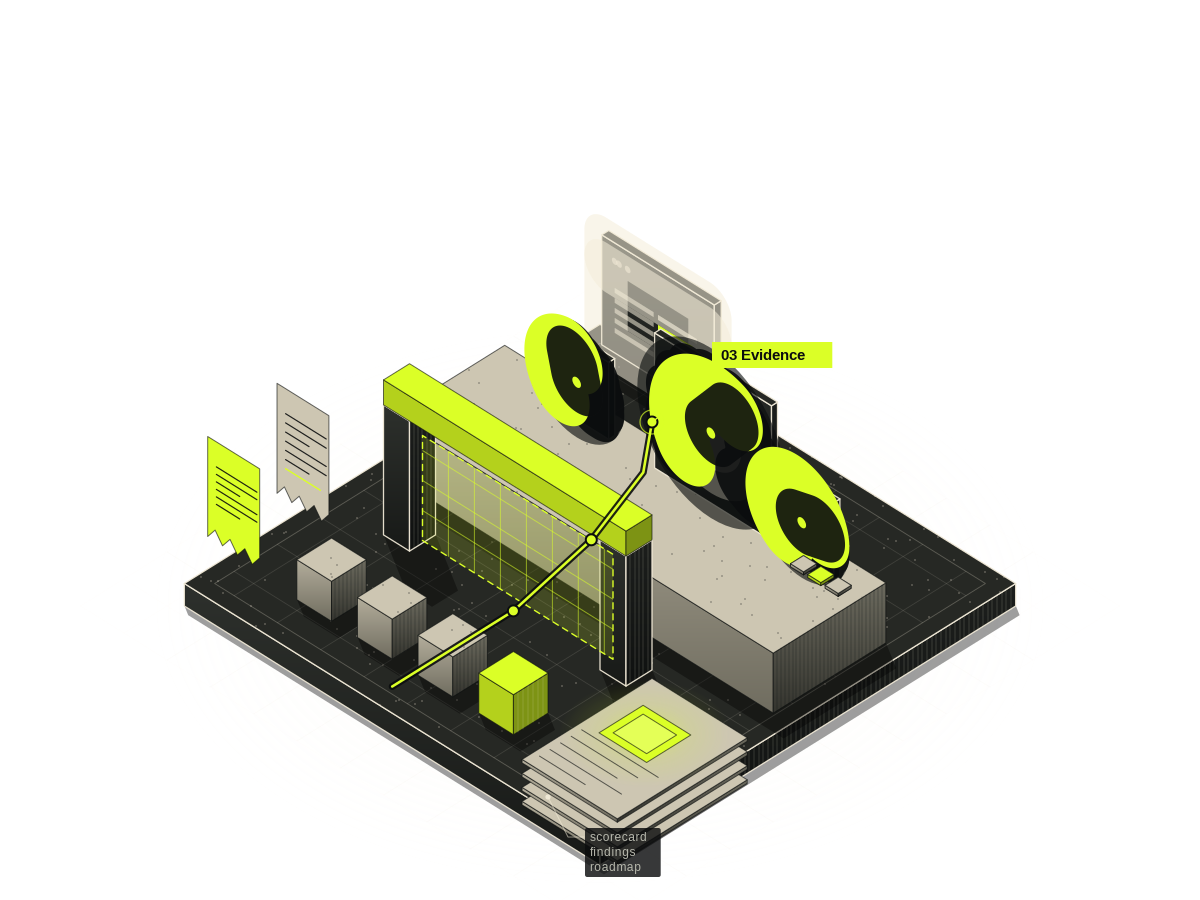
Evidence
I run what can be run and read the rest: test suites, evals, golden sets, adversarial probes where you have given a safe target. Every finding gets an evidence line.
Day 4
Gates, signals and rollback
I trace a change from commit to user: gates, flags, monitoring, rollback. I check the data flow against what you tell users.
Day 5
Report and walkthrough call
You get the written report, then we walk through it on a call: the scorecard, each finding with its evidence, and what to do first.
Deliverables
What you receive.
- 01
A short written report
Executive summary, scorecard, ranked findings, a 30/60/90 roadmap and an evidence appendix. The shape is the public sample report.
- 02
A readiness scorecard
Eight dimensions scored against a stated rubric, with the reason for each score written next to it.
- 03
Findings with evidence and fix sizes
Each finding names the file, config or run behind it, what it puts at risk, and a fix sized S, M, L or XL. Sizes are effort, not money.
- 04
A failure-mode map
What can go wrong in your feature and which cells have no check. It becomes the seed for your golden set.
- 05
A reproduction note per finding
The command or file path so your team can see what I saw, without me in the room.
The call
What you get on the walkthrough call.
- 01
The verdict first: ready, ready with conditions, or not ready, and the three reasons.
- 02
The scorecard, one dimension at a time, with the evidence behind each score.
- 03
The top findings in the order I would fix them, and the ones I would leave alone.
- 04
Your questions, including the uncomfortable ones. If your system is already solid, I say so.
- 05
Your options, plainly: fix it yourselves with the report, scope a sprint with me, or set up ongoing care. Doing nothing with me is a fine answer.
Limits
What the audit does not cover.
- Fixing anything. The audit ends in a plan; building is a separate, scoped piece of work.
- Penetration testing of your infrastructure, or load and capacity testing, unless scoped separately.
- Compliance certification or legal advice, including SOC 2, HIPAA and privacy law opinions.
- Re-running your production model at volume, or judging open-ended answer quality at scale.
- Anything outside the agreed scope, and anything I was not given evidence for. The report says so where it applies.
- A guarantee of any outcome. The report says what I found and what I would do about it.
Example findings
What a finding looks like.
Illustrative, from the public sample report. These are five of 10 real findings from an audit of this site, ranked by severity then fix size. They are not a client and not your system. Read all 10 with their evidence.
| ID | Severity | Finding | Fix size |
|---|---|---|---|
| R-01 | High | 396 API tests sit outside the release gate | S |
| R-02 | High | The headline eval result has no receipt you can re-run | S |
| R-03 | High | No gate checks model behaviour when a prompt or model changes | L |
| R-04 | Medium | The price backstop is skipped in one mode | S |
| R-05 | Medium | The privacy page does not name the model provider | S |
Fix size is relative engineering effort: S is part of a day, M a few days, L about a week or more. It is never a price.
After the audit
Where it goes from here.
The audit stands on its own. If you want help acting on it, the path is the same four stages as every engagement, and you can stop at any of them. The last stage is a monthly retainer, and it is optional.
- 01
Audit
about a week
The report and the call. This page.
- 02
Sprint
about two weeks, scoped
One visible fix from the roadmap, shipped and measured: usually the first gate.
- 03
Build
scoped
The larger items: eval battery, CI gate, rollout path, handed over with a runbook.
- 04
Operate
monthly, optional
Re-score the same card every month, keep the gates green, ship one improvement and send a proof report.
How each stage is scoped and handed over is on the method page; the ongoing options are on services. Everything is scoped and quoted in writing on a call.
Receipts
Claims on this page, with their status.
Verified
The sample report audits this site’s own surfaces; each fact cites a repo file.
Evidence index in the report appendix.
Evidence indexVerified
541 tests recorded, 540 passed, 0 failed, 1 skipped, across 52 files.
The site’s own scorecard. The API tests are not in it; that is finding R-01.
ProofSimulated
The eval-gate lab runs scripted answers. No model is called.
Run the labOwned
No client, testimonial or outcome appears here. There are none to show yet.
Real client results will be added only with written permission.
Questions
Frequently asked.
How long does the audit take?
About a week of working days once access is in place. We set the start date on the call.
What access do you need?
Read-only access to the repository or an export of the relevant files, your prompts, any eval data, and the CI configuration. A staging endpoint helps if you want probes run. I do not need production secrets or customer data, and I will tell you if I think I do.
What does it cost?
It is scoped and quoted in writing on the call. The scope is fixed and agreed before work starts. If you go on to a build, the audit fee credits into it, and if scoping shows I cannot help, it costs nothing.
Do you fix what you find?
Not inside the audit. You leave with a ranked plan you own, and you can act on it yourselves, with me or with someone else.
What if the system is already solid?
Then the report says so, shows the evidence, and lists what to keep watching. Telling you not to buy more is part of the job.
Is the sample report a real audit?
Yes. It audits this site’s own AI and QA surfaces, and every fact cites a file in the repository. It is labelled as a sample, not a client. It was written by the author of the system, so it carries that bias, and the report says so.
Who sees my report and my code?
Only the people you name. The report and everything produced is yours. A sample NDA and services agreement are public if you want paper before we start.
How does this become a monthly retainer?
Only if it helps. The audit gives you a scorecard. Some teams re-score it monthly and keep the gates green with me; others take the plan and run. The call covers which one fits.
Next step
Find out in a week whether it is ready.
Book a 15-minute call and we will scope it in writing, or answer three questions first and I will tell you which shape fits. The sample report is open, with a PDF, and needs no email.